April 15, 2026
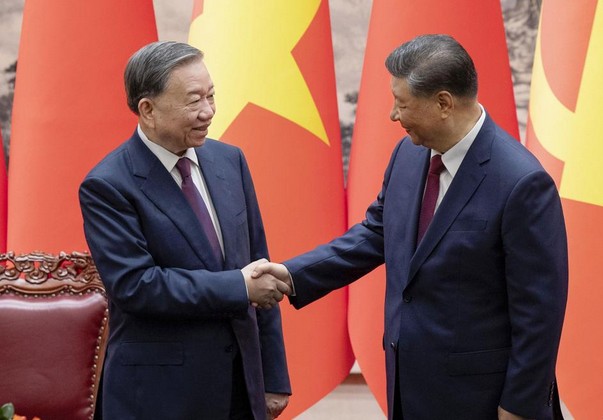
The newly “elected” President of Vietnam, To Lam, is making an official visit to China from April 14 to 17. This trip sends a clear political signal: Hanoi is becoming further dependent on Beijing for its legitimacy.
Since 2008,, the so-called “comprehensive strategic partnership” between Vietnam and China has been deeply asymmetrical. Under the leadership of the Vietnamese Communist Party, entire sectors of Vietnam’s economy—from textiles and electronics to construction and agriculture—have become reliant on China. This is not a normal partnership, but a systemic dependency. Any policy shift from Beijing—such as tighter border controls, export restrictions, or regulatory changes—could disrupt Vietnam’s entire production chain.
Moreover, China continues its illegal occupation of the Paracel and Spratly Islands, where it has built and militarized artificial islands. Chinese coast guard vessels frequently harass, detain, and confiscate the vessels of Vietnamese fishermen operating in their traditional fishing grounds. Most recently, China is constructing a new military installation at Antelope Reef in the Paracels just ahead of To Lam’s visit—without any formal protest from Hanoi.
Concerns are also growing in the technological domain. Hanoi is expected to sign a new agreement with Beijing on 5G infrastructure during this visit. While many European countries are restricting or removing Chinese telecommunications equipment from their 5G networks over fears of espionage and data control, Vietnamese authorities are strengthening this cooperation. This raises serious concerns for the data security of more than 100 million people. A telecommunications system dependent on China could become a gateway for surveillance and control over the entire society.
The model of social control developed by Beijing under Xi Jinping is increasingly reflected in Vietnam’s governance under General To Lam. From tighter control over cyberspace and expanded social surveillance to the use of technology to regulate citizen behavior, these practices are becoming widespread. Vietnam is undergoing a form of political “Sinicization,” where human rights are eroded under an increasingly authoritarian system.
General To Lam’s visit highlights the deepening dependency on Beijing, tying Vietnam’s future to a notoriously oppressive model. For these reasons, many Vietnamese — including the members of Viet Tan — strongly oppose To Lam’s visit to China and believe Vietnam must chart a new path in its foreign affairs.
The post Communist Vietnam’s New President To Lam Signals Deepening Dependence on China with State Visit appeared first on Viet Tan (EN).