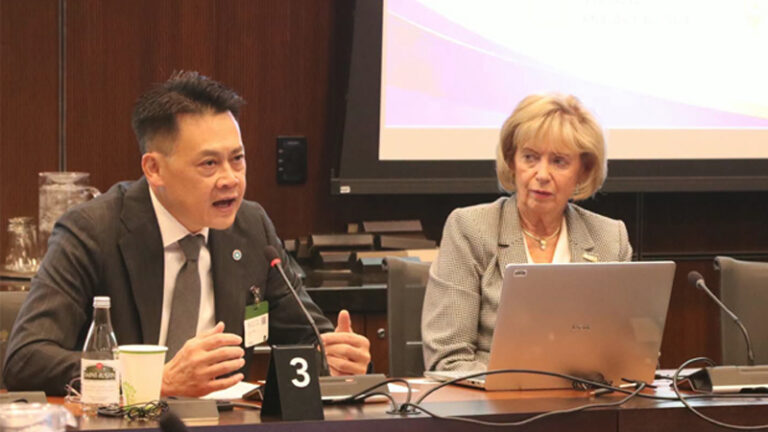
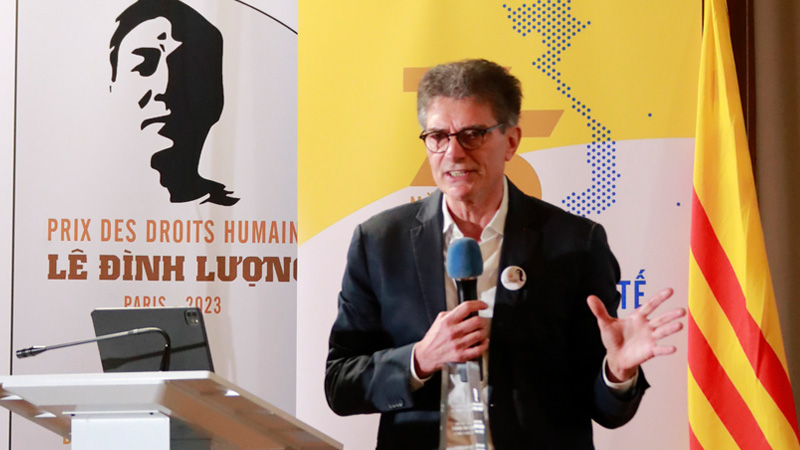
Speech by Pascal Durand, Member of the European Parliament, at the Le Dinh Luong Human Rights Award Ceremony, Paris, 10 December 2023
* * *
Ladies and gentlemen, dear friends,
First of all, I would like to thank Viet Tan for its invitation, and in particular its Advocacy Officer, Michel Tran Duc, whose commitment to defending human rights and fundamental freedoms in Vietnam within the European institutions has been unwavering.
As you know, I am aware that, through my presence here today, you wished to invite the European Parliament itself to this presentation of the Le Dinh Luong Human Rights Award, and I am particularly honoured to speak before you.
As you know, the European Commission sought to establish a free trade agreement with the Vietnamese communist regime, despite strong opposition from human rights defenders. This agreement includes safeguard clauses concerning the Vietnamese government’s respect for trade union rights and fundamental public freedoms, particularly freedom of the press.
Within the European Parliament, among those defending the liberalisation of trade, two different views of this agreement emerged:
- The first, an optimistic one, placed its faith in the ability of the agreement itself to influence and moderate the positions of the Vietnamese executive.
- The second called for ratification to be conditional upon the prior and effective implementation of changes in the government’s repressive policies, for example through the release of political opponents and journalists.
It will come as no surprise to you that I supported the second option, as I had no confidence in the spontaneous willingness of an authoritarian government to implement, at some future date, mere promises concerning respect for human rights.
Yet, by a large majority, the European Parliament made the surprising gamble in April 2020 of believing these promises and trusting the goodwill of the Vietnamese government.
Once again, Europe demonstrated, at best, a profound lack of understanding of how communist regimes operate and sheer naivety; at worst, an appalling cynicism, by placing trade and financial flows above the suffering of millions of human beings, their freedom, their dignity, and even their very lives.
Let us be precise: the EU signs trade agreements of various kinds with numerous totalitarian states, whether on the far right or the far left, but all of these agreements include safeguard clauses concerning respect for human rights and fundamental freedoms.
Unfortunately, such commitments remain mere empty promises if the EU does not give itself the effective means to exert influence over the public policies of these states.
When journalists, human rights defenders and ordinary citizens are threatened, arbitrarily arrested, imprisoned, tortured or killed, and when independent NGOs document these abuses, it is obvious that the European Union has a moral duty and political and economic responsibilities to intervene and act, using the only leverage that it has itself established: the suspension of the trade agreement, or at the very least the threat of suspension or its revision.
Only the credible implementation of such sanctions could compel the Vietnamese government to modify, even partially, its repressive system.
That is not yet the case, but I remain convinced that, particularly through the mobilisation of civil society, we can make it happen.

Public events such as the one taking place today are essential because they send a threefold message:
- First, they offer a glimmer of hope to all those suffering in Vietnamese prisons, persecuted and physically abused because of their freedom to think or speak, who know that we have not forgotten them and will not abandon them.
- Second, they make it clear to the Vietnamese government that the Vietnamese diaspora, human rights defenders within the EU and in France, are not fooled by commitments that have not been honoured to date, and that we will all remain mobilised alongside associations and NGOs until the EU-Vietnam Free Trade Agreement is fully respected in terms of fundamental freedoms, human rights and trade union rights.
- Finally, they alert the European institutions to the need for genuine monitoring of such agreements and to prepare to implement sanctions so that the commitments made are actually honoured.
If you will allow me, I would like to conclude my remarks on a more personal note, by addressing a child who is here today in this room alongside his mother.
I would like him to know that he bears the Vietnamese name Tung in honour of his grandfather, who was forced to board a small boat clandestinely, at the risk of his own life and that of his entire family, one summer night in 1975, departing from a pier in Saigon on an old makeshift boat, leaving behind, with no hope of return, his country, his city and the land of his ancestors.
My own grandfather had also been forced to flee another dictatorship, a fascist one, many years earlier.
May these intertwined destinies oblige you—and oblige all of us—to honour the memory and stand alongside, in the present, all those who defend freedom, human dignity and fraternity.
Wherever they may be persecuted or forced into exile, may their example invite you to walk, humbly, in their shadow.
Pascal DURAND
Member of the European Parliament
The post From commitments to action: Europe must defend human rights in Vietnam appeared first on Viet Tan (EN).