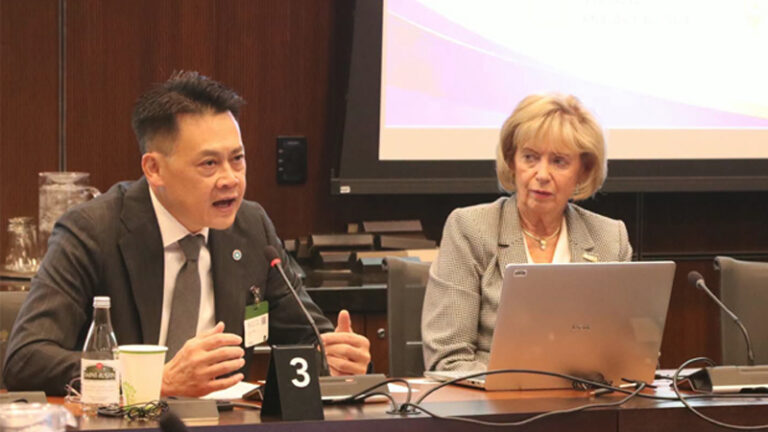
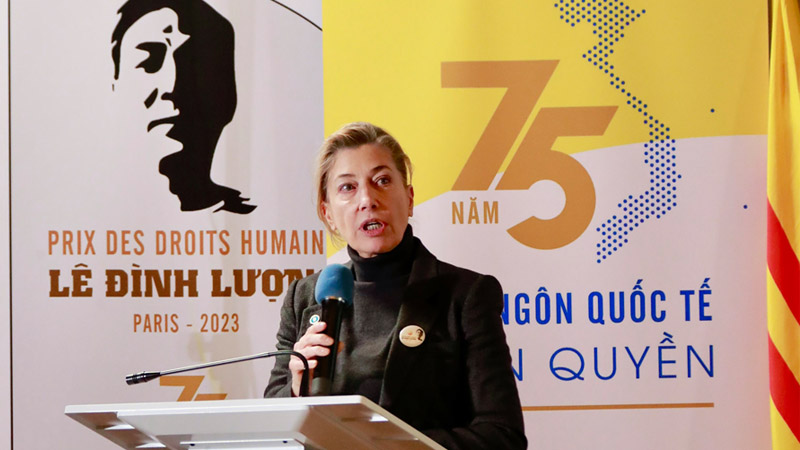
Speech by Pascale Berry-Wavre, Member of COSUNAM, delivered on 10 December 2023 in Paris at the Le Dinh Luong Human Rights Award Ceremony
* * *
Good morning/afternoon to everyone gathered here today for the presentation of the Le Dinh Luong Human Rights Award.
Before speaking about three women activists who are currently detained in Vietnam, I would like to say a few words about the hundreds of thousands of Vietnamese women who simply want to have a job, a healthy life, and a functioning healthcare system. But beyond these basic aspirations, they also want an education for their children based on universal knowledge rather than indoctrination; to live in a country with an independent and impartial justice system; and to live in a country without violence.
And yet, in Vietnam, none of these basic needs can be taken for granted. Women who become activists fight at the risk of their lives for the recognition and defence of these rights.
Before discussing three women activists who are currently imprisoned, I would like to highlight the extremely difficult situation faced by the wives of prisoners of conscience in Vietnam.
Their financial situation is often precarious following the arrest of their husbands, and they frequently have to travel thousands of kilometres every month to visit them. This is part of the authorities’ deliberate effort to inflict a form of psychological torture on prisoners’ families.
These journeys are costly, and the women must overcome numerous difficulties in order to bring their husbands medicine, clothing and food in prison.
The first of these remarkable women I would like to portray is Ms. NGUYEN THUY HANH, founder of the 50K Fund.
The initiative allowed people to make a modest donation, equivalent to around four euros, so as not to arouse suspicion, in order to support the families of political prisoners who had no resources to cover the costs of prison visits, schoolbooks and tuition fees.
Created in 2014, this movement, which was entirely legal, grew considerably, and the authorities became concerned about its success both in Vietnam and abroad. Participants subsequently faced severe sanctions, and in 2020 the Fund was blocked.
Arbitrarily arrested in April 2021, Ms. NGUYEN THUY HANH is currently detained in Hanoi.
A few days before her arrest, Ms. NGUYEN THUY HANH gave an interview in which she spoke about the Vietnamese people who had contributed to the 50K Fund. She said:
“Through this action, they affirm their share of responsibility and proudly take their place in society.”
This statement is deeply admirable because it tells us that citizens have rights and responsibilities. Even in a context as brutal as the dictatorship in Vietnam, this means overcoming fear.
She also told us:
“These committed people have done something meaningful with their lives.”
Living under a dictatorial regime where individual freedoms are trampled upon, these words resonate deeply.
Today, her struggle is known throughout Vietnam and beyond. The visible face of the struggle may appear to have slowed down somewhat, but its submerged side is continuing to consolidate.
In 2019, Ms. NGUYEN THUY HANH was the recipient of the Le Dinh Luong Award.
I would now like to speak about Ms. HUYNH THUC VY, a committed activist and journalist who ran a blog documenting human rights violations, particularly violations affecting women, as well as environmental issues.
She is the author of the book A Look at Truth, Freedom and Human Rights, which provides a detailed account of human rights violations in Vietnam.
Her call is simple: “I want to live with dignity and freedom.”
In 2013, she founded, together with eight other people, the Vietnamese Women for Human Rights group.
This independent, non-political and non-profit organisation aims to protect women from violations of their fundamental rights by the authorities, by providing them with material and psychological support and by widely disseminating knowledge about individual freedoms.
She is fighting against an omnipresent totalitarian regime that controls the country’s economy, the military, cultural circles and the minds of its people.
According to HUYNH THUC VY, people become demotivated in such a climate of oppression, which allows the government to remain in power.
She was arrested in August 2018 and sentenced to 33 months in prison for spraying paint on the Vietnamese flag. The sentence was suspended because her second child was under three years old at the time.
In November 2021, the authorities decided to enforce the 33-month sentence.
In October 2022, she was beaten and strangled by prison guards after she spoke to her daughter about the conditions of detention of prisoners who had been deprived of access to telephone calls and the right to receive visitors.
The last imprisoned woman in Vietnam whom I would like to speak about today is Ms. CAN THI THEU, the mother of TRINH BA PHUONG and TRINH BA TU.
These three activists belong to one of the most courageous families of land-rights and human rights defenders in Vietnam.
In June 2020, police officers came to arrest her eldest son at his home. At the same time, CAN THI THEU and her younger son were arrested 70 kilometres from Hanoi.
TU was violently beaten.
In December 2021, they were sentenced to lengthy prison terms: eight years for Ms. CAN THI THEU and her younger son, and ten years for her eldest son.
These sentences were handed down because they challenged the official version of the bloody confrontation that shook the Dong Tam community in February 2020.
It is important to recall here Article 117 of the Vietnamese Criminal Code, which prohibits the “manufacture, storage, dissemination or propaganda of information (…) with the aim of opposing the State.”
This law is frequently used in Vietnam to repress dissidents and imprison protesters.

Viet Tan is committed to reforming Vietnam’s authoritarian one-party system in order to build a democracy through non-violent means.
The party does not seek to overthrow the current government through a popular uprising, but rather through peaceful means, relying on the strength of the Vietnamese people and promoting human rights.
This means informing the population about their fundamental rights and freedoms, such as freedom of opinion and expression, freedom of assembly and freedom of association.
In Vietnam, these rights and freedoms are violated and suppressed through often brutal arrests and lengthy prison sentences, as we have just seen.
It is through a vast network of independent journalists and human rights defenders, both inside and outside Vietnam, that this information reaches the population.
In Vietnam, those who become involved risk their lives, whereas we who live in democratic states enjoy these rights. It therefore seems obvious to me that we should support this party.
It was in 2010, following a mission my late husband, Rolin Wavre, had undertaken in Vietnam to deliver strictly personal family messages to prisoners of conscience, that I first learned about this party.
By coincidence, on 10 October, during the celebrations marking the millennium of Hanoi, Viet Tan held a peaceful demonstration in the centre of the capital, and Rolin happened to be there at the same time.
Upon his return to Switzerland, he was able to bring back footage he had taken on the spot, documenting the violent police crackdown against peaceful demonstrators. He subsequently broadcast these images on a Swiss television channel.
The post Overcoming Fear: The Courage of Women Defending Human Rights in Vietnam appeared first on Viet Tan (EN).