January 19, 2026
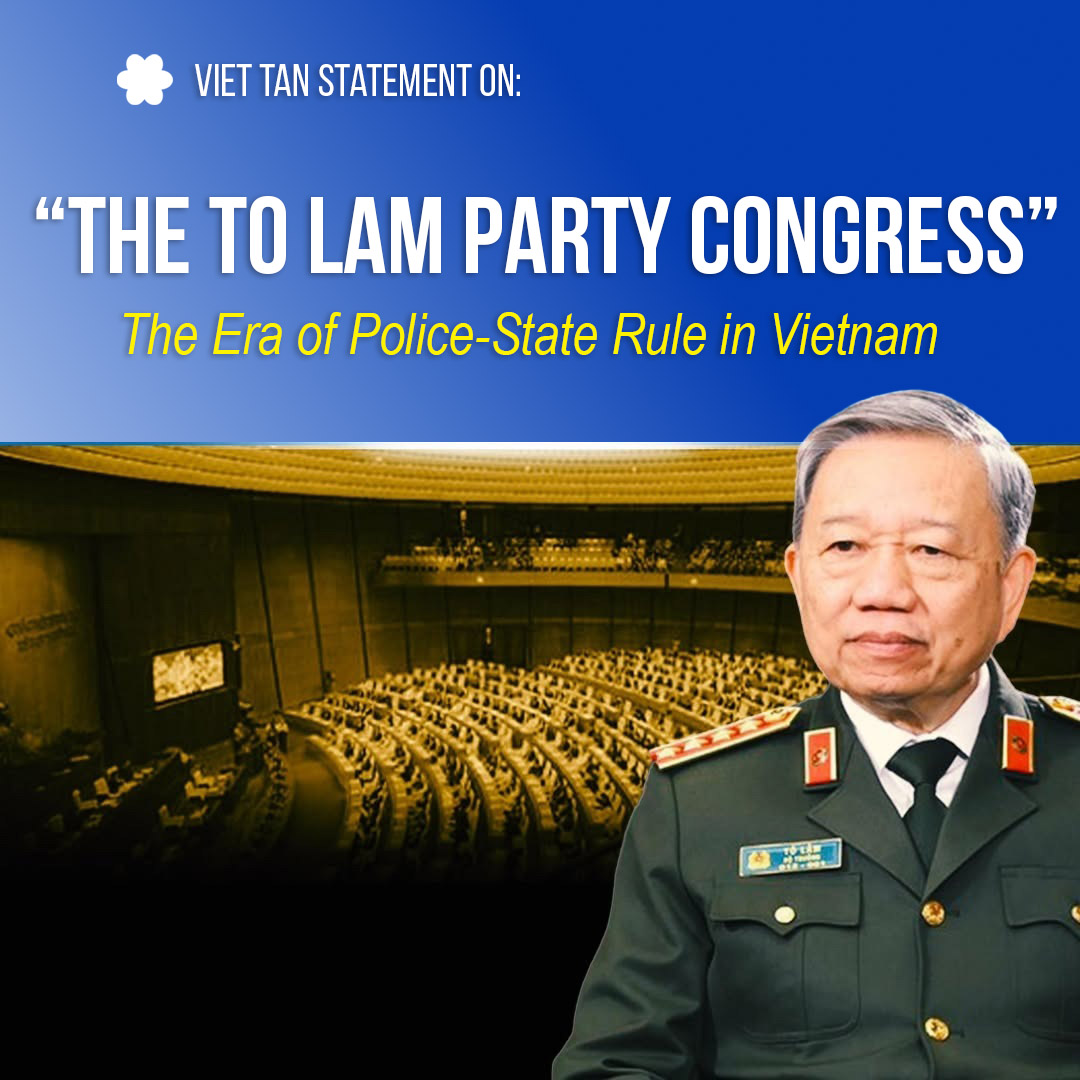
The “To Lam Party Congress” Establishes the Era of Police-State Rule in Vietnam
The Communist Party of Vietnam officially opens its 14th National Congress today.
In the run up to the conclave, To Lam declared that the Congress will determine the country’s direction for the next five years. Thus, the “true owners of the nation” have been completely sidelined—subject to intimidation, monitoring and imprisonment. An atmosphere of fear once again blankets the country, just as it has during previous Party congresses.
This Congress lays bare the extent of Police General To Lam’s grip on power. His campaign to consolidate authority—by sidelining rivals and installing loyalists in key positions—began in the final months of General Secretary Nguyen Phu Trong’s tenure and continued unabated up to the eve of the 14th Congress. It is therefore difficult to view this gathering as anything other than the “To Lam Congress,” one that will only further accelerate policies aimed at entrenching the dominance of the Hung Yen faction.
There are three inherent features—and corresponding pitfalls—of the To Lam regime.
First, To Lam signature “reforms” are likely to usher in a period of crony capitalism, in which interest groups aligned with the regime dominate the economy. Rather than unleashing the dynamism of the Vietnamese people through genuine free enterprise and an open society, an expansion of state capitalism would deepen corruption and foster an oligarchic system.
Second, the so-called “bamboo diplomacy” promoted by his predecessor and intensified by To Lam since he became general secretary in 2024 points toward a foreign policy aimed primarily at preserving the regime’s monopoly on power, rather than advancing the nation’s socio-economic development. As a result, Hanoi cannot be a reliable partner in a free and open Indo-Pacific, as its core interests will continue to align with Russia, China, and other authoritarian regimes.
Third, the security apparatus that propelled To Lam to power and now dominates Vietnamese politics has pushed the country toward a police-state. Following a multi-year crackdown on peaceful dissent, Vietnamese society under To Lam’s rule risks coming to resemble China’s “human camp,” in which citizens are monitored continuously—from actions to thoughts—forced to live in constant fear, and subjected to severe punishment for holding views that differ from those of the ruling authorities.
General To Lam and the Communist Party of Vietnam cannot shift responsibility for the damage inflicted on Vietnam’s land and people under their own oppressive rule.
Yet Vietnam’s future does not belong to repression. It will be forged when the people are free to rise, to speak, and to shape their own destiny. Vietnam deserves a genuine democracy—one in which the people themselves choose a government that serves the common good and places the nation above all factions, interests, and parties.
***
Read the statement in pdf: Viet Tan statement on the _To Lam Party Congress” (January 19 2026)