September 4, 2008
Later this month, the U.S. State Department is due to release its annual report on international religious freedom. Recent events in Vietnam suggest the chapter for that country will not, or at least should not, be positive.
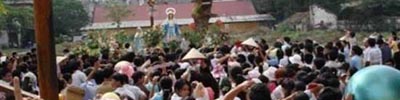
For the last two weeks, several hundred Catholics from Hanoi’s Thai Ha parish have been protesting for the return of parish property first seized by the Communists in the 1960s. The parish needs to build a new church to accommodate its swelling membership, Father Vu Khoi Phung told us by telephone. Several parishioners reportedly have been beaten by police while participating in peaceful prayer vigils. This is part of a developing pattern of protests, and then state suppression, by Catholics seeking return of long-ago-expropriated church lands.
Catholics are not the only believers who face problems with the Communist Party state. Last week, the U.S. Commission on International Religious Freedom — an independent commission within the White House — released its latest report on Vietnam. The commission documents a range of abuses, from attacks against the Unified Buddhist Church of Vietnam to bans on indigenous Vietnamese religions such as Hoa Hao and Cao Dai. In some provinces, local officials bar Protestant children from high schools, citing old communist laws excluding children of religious families from school. Believers of many kinds are still sometimes forced to publicly renounce their faith, even though Hanoi had promised to end this practice.
Given this pattern of behavior, the State Department may want to put Vietnam back on its list of “Countries of Particular Concern” for violations of religious freedom. When the U.S. first put Vietnam on the list in 2004, it had an immediate effect. Hanoi was so embarrassed that it released many religious “prisoners of concern” and said it would allow more sects to register as official organizations. As a reward, Vietnam was removed from the list just before President Bush travelled to Hanoi for an Asia-Pacific Economic Cooperation summit in 2006. Since then, State has argued that repression in Vietnam is mainly secular and that believers are jailed for political activism rather than for their religious beliefs.
Hanoi has made some progress on religious freedom, especially in reaching a deal with the Vatican under which the Catholic Church secured greater freedom to appoint bishops and priests. But such advances are now stalling. Recent events — both the treatment of religious land protesters and the cases documented by the commission — suggest there’s still good reason to be “particularly concerned” about religious freedom in Vietnam.